
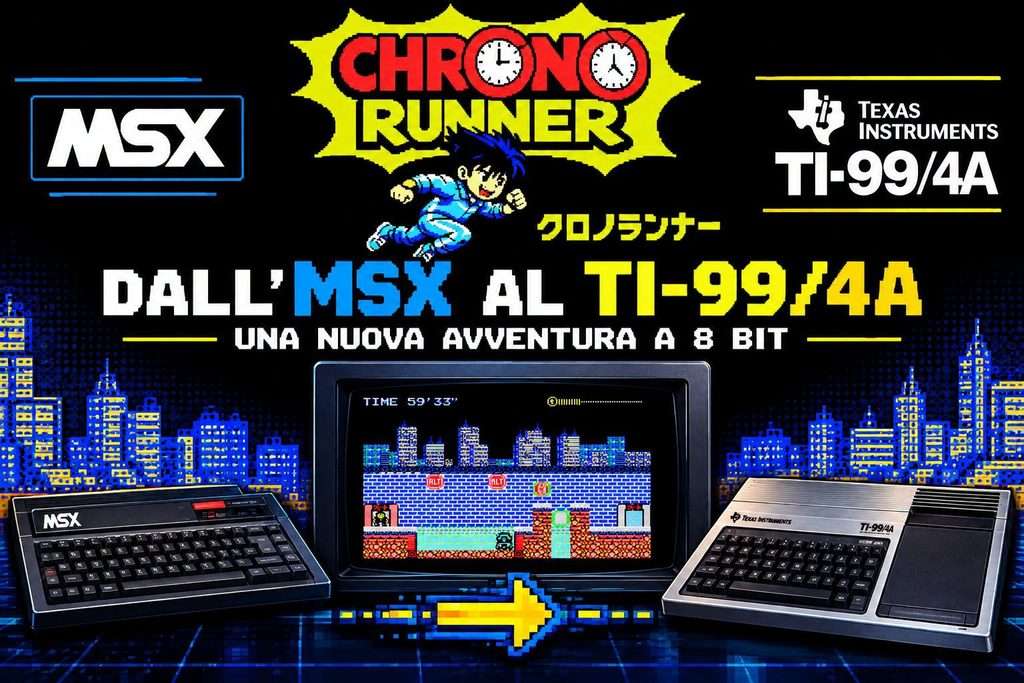
Certain passions are born in childhood and never leave us. Sometimes, decades later, they lead us to pick up an old camera and imagine something that, in the 1980s, would have seemed almost impossible!
This is precisely the story that accompanies the conversion of Chrono Runner for the legendary Texas Instruments TI-99/4A, told by its author, Fabrizio Luglio, a member of our game's first development team, composer of the music and author of part of the original graphics! 

 FROM THE TI-99/4A TO THE MSX: A PASSION THAT RETURNS
Fabrizio is a fan of the TI-99/4A, the computer he played with as a kid, before discovering the world of MSX through a Philips VG-8020.
The TI-99/4A thus represents an important piece of his personal computing history. And this very connection sparked an idea: why not try porting the game he had personally contributed to to that machine?
Thus began a new adventure: taking Chrono Runner, ideally dismantling its mechanisms and rebuilding them for a different architecture, preserving as much of the experience of the original as possible.
 DISASSEMBLING AND REASSEMBLING CHRONO RUNNER
The MSX1 version was developed in C language using MSXgl, a library that provides numerous functions for managing graphics, controls, the protagonist's physics, music and sound effects.
For the porting, Fabrizio had to tackle a job of adapting and rewriting the code.
The character physics and collision module was rewritten in CVBasic, faithfully replicating its behavior with the help of Claude Code. The rest of the game was translated, block by block, from C to the native CVBasic instructions.
But not everything could be entrusted to BASIC!
The most critical parts, such as enemy management, time rewind, the final boss and interrupts, were implemented in TMS9900 assembly, the machine language of the TI-99/4A processor.
The music and sound effects also required specific work: using Python scripts, the audio data was adapted to the SN76489 sound chip of the Texas Instruments machine.
A job of programming, testing, corrections and debugging that required several months of free evenings and a few weekends.
 ONE 128KB CARTRIDGE FOR A COMPLETE GAME!
The TI-99/4A version uses a 128 KB cartridge with bank switching, a technique that allows the program to be divided into multiple memory banks that can be selected during execution.
The main bank contains the game's main logic, while the other thirteen banks house graphics, levels, screens, narrative sequences, audio, and the final boss.
The cutscenes have also been redesigned: in the original they were C scripts, while in the conversion they became a sequence of instructions, a sort of little script interpreted by the game.
An ingenious solution to make all the elements of Chrono Runner coexist with the features of the platform.
 PIXEL BY PIXEL: THE SECRET IS IN THE HARDWARE!
And here's the part that will make MSX and TI-99/4A enthusiasts smile.
The two machines share the TMS9918A video processor, also used in the MSX1. This allowed Fabrizio to directly transfer tilesets, maps, colors, and sprites from the original version, without having to convert graphics formats.
The result? Chrono Runner graphics on the TI-99/4A are identical to those of the MSX version, pixel for pixel! 
Of course, having the same graphics chip doesn't mean the two computers are the same. The CPU, memory, keyboard, and sound system are different, and that's where most of the work went.
A concrete demonstration of how hardware knowledge and a programmer's creativity can bring two historic platforms together.
 A PROJECT BORN FROM PASSION
There's a particularly beautiful aspect to the story of this conversion: Fabrizio isn't a programmer arriving from abroad to try his hand at an unknown game. He's one of the team members who brought Chrono Runner to life, composed the original music, and contributed to its graphics.
He therefore knows the game from the inside and has chosen to dedicate part of his free time to a new challenge, bringing it back to a computer that accompanied his youth.
As he himself says, it's a pleasure to be able to introduce the game to fans who are new to the MSX world. And who knows, maybe this conversion will inspire other developers to bring Chrono Runner to other 8-bit platforms!
For us at Associazione MSX Italia, seeing one of our projects transcend the confines of the platform for which it was created is a beautiful testament to the vitality of the homebrew scene and the collaboration between enthusiasts.
 Thank you, Fabrizio, for bringing Chrono Runner into a new computing dimension!
 WANT TO PLAY CHRONO RUNNER ON YOUR TI-99/4A?
You don't need to own the original computer: you can also try it using the online JS99er emulator.

The controls are the same as the MSX version, with two additions:
 FCTN+9, or ALT+9 on PC, to skip the intro.
 The M key to turn music on or off.
 MSX, TI-99/4A and a shared passion: that for computers that have made history and that, even today, continue to give us new adventures!
The file is available here:
The CVBASIC source is available here on Github: https://github.com/fablug-wq/chrono-runner-ti99
Below are the manuals, in Italian and English:Chrono_Runner_TI99_manual_IT or Chrono_Runner_TI99_manuale_EN.pdf